 This seems to be quite a hot topic. Very few people are willing to tell the truth about dairy. In fact, criticizing milk in America is like taking on motherhood, apple pie or baseball (Mark Hyman, MD).
I first became curious about others living dairy-free when Aliyah was born. I went to a breastfeeding support group through the hospital that is ran by a board certified lactation consultant. Every week new moms would show up with questions about their breastfeed babies having upset stomachs, digestive issues, gas, eczema, sleeplessness and colic. The more experienced moms would recommend giving up dairy over and over again. The lactation consultant would agree. And when a friend gave up dairy to find a much happier (breastfed) baby, this got me thinking, "What is it about dairy negatively affecting a breastfed baby?!? Milk is supposed to be good for you, right? Got Milk! Right?"
(La Leche League article about lactose intolerance, diarrhea, and allergy in breastfed infants - It's NOT your breast milk, it's the substances passed through the breast milk. Most infants will respond to eliminating cow's milk in mom's diet. Eliminating multiple foods is not necessary as a first line of therapy.)
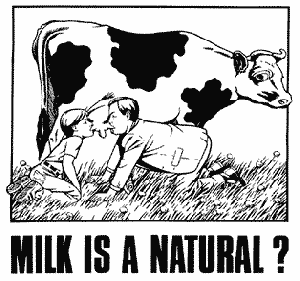
Cow's milk is nature's perfect food... for a calf!
Our bodies just weren't made to digest milk on a regular basis. Instead, most scientists agree that it's better for us to get calcium, potassium, protein, and fats from other food sources, like whole plant foods - vegetables, fruits, beans, whole grains, nuts, seeds, and seaweed.
Our bodies weren't made to digest milk on a regular basis? This was shocking to me. I kept reading and researching to find an even more shocking fact: About 75% of the world's population is genetically unable to properly digest milk and other dairy products (lactose intolerant). 75%?!?!
So this got me thinking some more... If babies are benefiting from their moms dropping dairy from their diets and 75% of the world's population have a hard time digesting dairy, why would the USDA (United States Department of Agriculture) create a health food pyramid that recommends drinking 3 glasses a day?
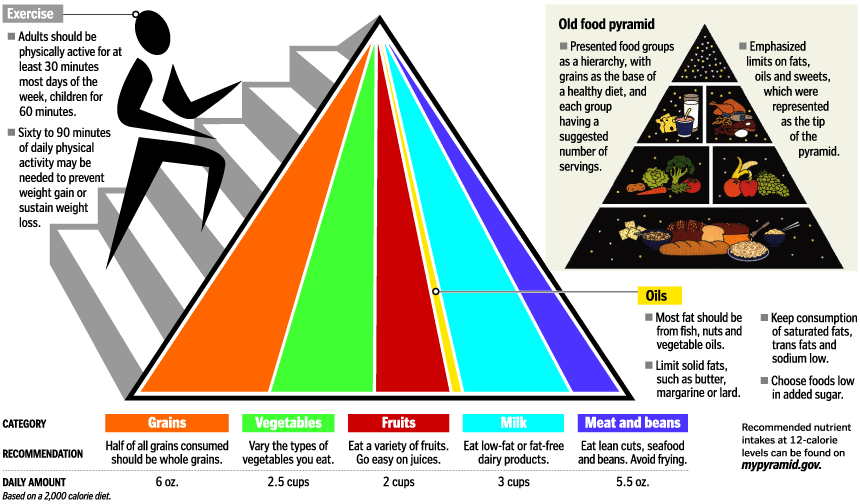
Unfortunately, I found that this recommendation is not based on science alone (or even our best interests) - some of the "experts" who helped create the food pyramid work for the dairy industry (WHAT?) And remember in the early 1990s when the pyramid recommended 6-11 servings of bread/cereals a day?!?

What about the Got Milk? campaign? The USDA was asked to look into the scientific basis for their milk mustache ads. The scientists stated this:
• Milk doesn't benefit sports performance.
• There's no evidence that dairy is good for your bones or prevents osteoporosis - in fact, the animal protein it contains may help cause bone loss.
• Dairy is linked to prostate cancer.
• It's full of saturated fat and is linked to heart disease.
• Dairy causes digestive problems for the 75 percent of people with lactose intolerance.
• Dairy aggravates irritable bowel syndrome.
• Dairy may contribute to other health issues like: allergies, sinus problems, ear infections, type 1 diabetes, constipation, and anemia in children
BOTTOM LINE: Dairy is okay for some, but it is NOT crucial for good health!
There are more shocking facts about milk/dairy that I have found since I have first started researching the health benefits of living dairy-free. Here are a few other articles I liked:
LLL: Allergies and the Breastfeeding Family
The Birth Place: Cow's Milk
Huffpost Living: Dairy
When I first thought about taking milk out of our diet I said, "No Way! Nobody in our family has been labeled lactose intolerant... But now that I've actually seen the benefits that our whole family are reaping, it seems like a no-brainer.

Here is what Dr. Walter Willett, (author of "The Fertility Diet" & "Eat, Drink and Be Healthy" and current nutrition department chair at Harvard) the second most cited doctor in clinical medicine, recommends:
1. Not sure? Try a dairy-free diet for two weeks and see what you find. (We experience less headaches, sinus issues and problems with allergies. We've also lost weight and gained energy.) If you go back to dairy and feel worse, try giving it up forever!
2. If you can tolerate dairy, use only raw, organic dairy products. Focus on fermented products like unsweetened yogurt and kefir, occasionally.
3. If you have to feed your child formula from milk, don't worry. The milk in infant formula is hydrolyzed or broken down and easier to digest (although it can still cause allergies). Once your child is a year old, switch him or her to almond milk.


Moooooovin' on!
ReplyDeleteLove, Grandpa
i've never liked drinking milk, and i was always too stubborn to be forced. i think my parents preferred me to drink water anyway, it's cheaper. but CHEESE...well, that's another story. =)
ReplyDeleteBut I LOVE milk!! :P
ReplyDeleteThat is all terrible information that, although I was not aware of, have assumed. When my family questioned why I wouldn't start Lilly on cow's milk, I explained that it was meant for a 40 lb. calf, so while Lilly is only a 20 lb. human, I don't believe it's the best thing for her. However, I'm not sure I could give it up, health benefits or not. My friends tease me that I drink milk "like a man" because I go through a gallon a week, ALONE. Josh doesn't really drink milk, and as for Lilly I've been splashing some Shatto into her water since her birthday; but just a splash. I suppose if I had headaches, allergies or sinus problems, maybe I could convince myself to give it a shot... but ugghhh give up milk?!? I'm more willing to give up my laundry detergent and certain types of shampoo, toothpaste, etc. that they've labeled hazardous to our health.
I will say that I have decided not to feed my family any pre-packaged, preservative packed "convenient" food. Definitely taking the approach that if I can't understand what's in it, we don't need it. I'm also concerned with sugar, (as much as I love it) and whether or not it's really something "meant" for our consumption.
Isn't it amazing all the things you start looking into when you're protecting someone other than yourself??
Thanks for this read, because I had been wondering the "whys" and "hows" of your new dairy free lifestyle! What does your pediatrician recommend for a "replacement," or how much of a replacement? I have a few friends who don't drink milk at all and I believe they're extremely healthy, but I worry that I don't know exactly how much a baby should consume of other products for protein, etc.
ReplyDeleteAlmond milk is delicious. In fact Amelia can tolerate a small amount of dairy in my diet, but I still choose to drink Almond milk. When Amelia is a year old I will transition her to Almond milk as well. Almond milk has more calcium and less calories and, in my opinion, tastes delish. When I need to cook a recipie that has dairy in it, I replace it with coconut milk...yumm!
ReplyDeleteCourtney Walston
I would also like to add that Amelia was a different baby after I eliminated dairy from my diet. The proteins in cows milk are difficult for many babies digestive systems to break down, causing gas and tummy cramps. When my lactation consultant told me to eliminate milk I thought there was no way I could do it! Like Trisha I drank a gallon of milk a week , and I love yogurt. Once I got past the two week mark I didn't miss it anymore!
ReplyDeleteCourtney
ROCK ON COURTNEY!!! I never really liked milk, but cheese - I thought that would be really hard. Now, after doing it for a while, it seems like a piece of cake! We like almond milk too (that is also what Aliyah will start drinking next month). We have also been eating tons more veggies than we used to (chalked full of calcium & other vitamins)... BTW - Courtney, your the mama I was thinking of when I mentioned a friend giving up dairy!!! <3
ReplyDeleteALSO... This is prob a combo of breastfeeding and giving up dairy, but I just weighed myself for the first time since my 6 week follow up after Aliyah was born: I am 5lbs lighter than I was right before I had Aliyah!!!!!
ReplyDeleteI would like to add that 75% of world does not have access to the dairy cows that we do in the US. So technically how can one compare us to the rest of the world that does ancestors have not built up the enzymes to be lactose tolerant.
ReplyDeleteYou go girl! :) I LOOVE this!
ReplyDelete